
The D1 minibus licence is one of the most commonly misunderstood categories on a UK driving licence. Whether you need to drive a school minibus, a community transport vehicle, or a private ambulance, the rules around who can drive a minibus—and when you need a D1—are not always straightforward. This guide covers everything you need to know about the D1 licence in 2026, including the exemptions that might mean you do not need one at all.
What Is a D1 Minibus Licence?
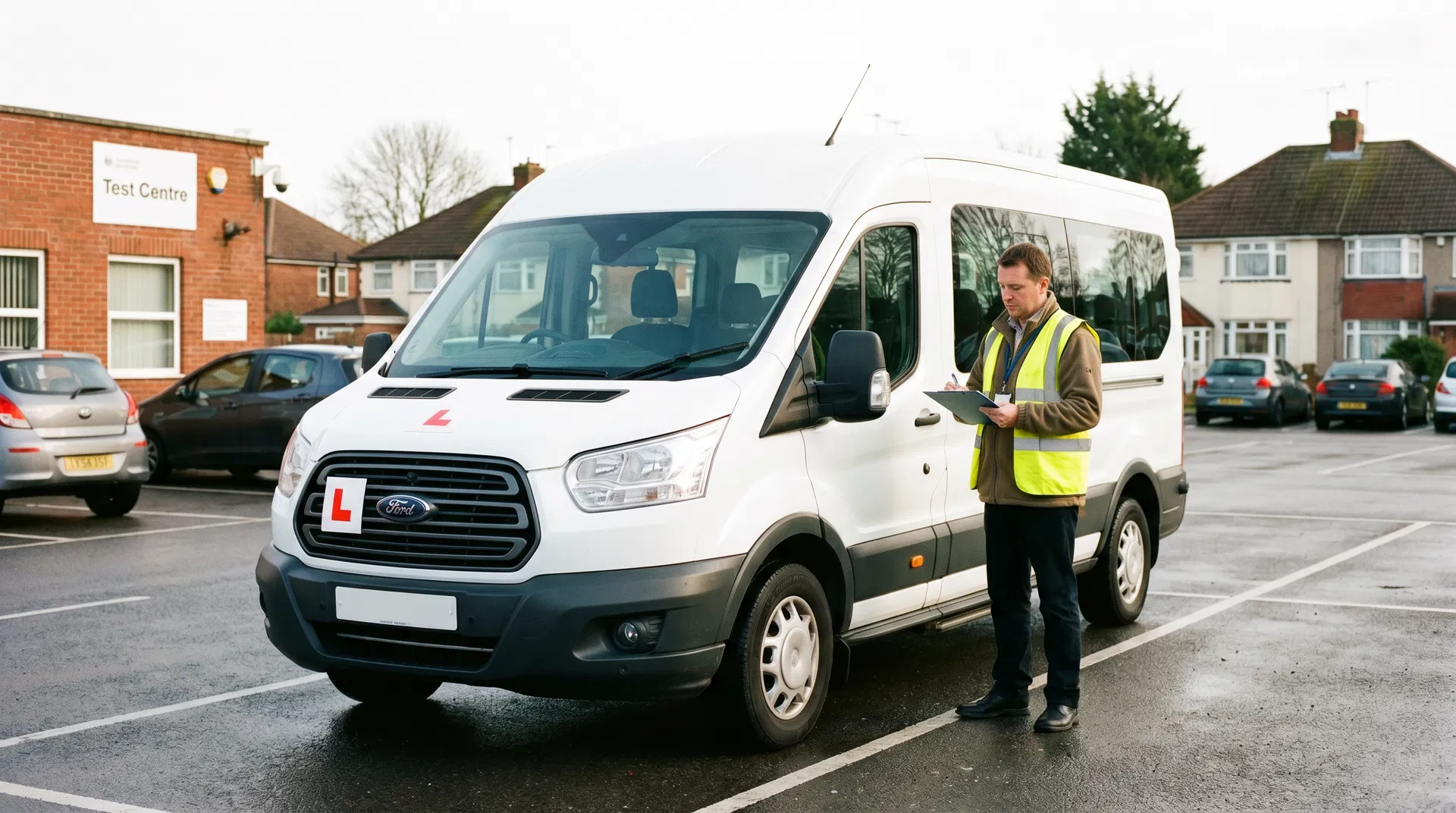
Category D1 is the UK driving licence entitlement that allows you to drive a minibus. This is defined as a vehicle with between 9 and 16 passenger seats (plus the driver), with a maximum length of 8 metres. With a standard D1 licence, you can also tow a small trailer with a Maximum Authorised Mass (MAM) of up to 750 kg.
If you need to tow a heavier trailer, you will need Category D1+E, which allows a combined vehicle-and-trailer MAM of up to 12,000 kg.
Do I Already Have a D1 Licence?
This depends entirely on when you passed your car driving test:
| When You Passed | D1 Status | Details |
|---|---|---|
| Before 1 January 1997 | Yes — automatic | You received D1 (and D1+E with restrictions) under grandfather rights. Check the back of your licence or use the GOV.UK licence checker. |
| On or after 1 January 1997 | No — requires separate test | You must apply for a provisional D1 entitlement and pass the PCV theory and practical tests. |
If you passed before 1997, look at the back of your photocard licence. You should see D1 listed in the categories table. Note that your D1 may have restriction code 101 (not for hire or reward)—this means you can drive a minibus for voluntary or personal purposes but not as a paid service.
Can I Drive a Minibus Without a D1 Licence?
Yes, in certain limited circumstances. The UK has a specific exemption that allows Category B (standard car licence) holders to drive a minibus without a D1, but all of the following conditions must be met:
- You are 21 years or older
- You have held your Category B licence for at least 2 years
- The minibus has a MAM of no more than 3,500 kg (or 4,250 kg if it is a zero-emission electric or hydrogen vehicle)
- You are driving on a voluntary basis—not for hire or reward
- The vehicle is used by a non-commercial body for social purposes
If any one of these conditions is not met, you need a full D1 licence. In practice, this exemption is mainly used by charities, churches, sports clubs, scout groups, and community organisations using their own minibuses for group trips. For more details on what you can drive, see our D1 minibus licence page.
Important: If passengers contribute towards the cost of fuel or the trip, this may be considered "hire or reward" depending on the arrangement. If in doubt, get a D1 licence to be safe. Driving a minibus without the correct entitlement can result in a fine of up to £1,000, penalty points, and your insurance being invalidated.
D1 Licence vs D Licence: What's the Difference?
Category D1 covers minibuses (9–16 passenger seats, max 8 metres long). Category D covers full-size buses and coaches with more than 8 passenger seats and no upper limit. If you want to drive a 52-seat coach or a double-decker bus, you need a Category D licence, not D1.
| Feature | D1 (Minibus) | D (Bus/Coach) |
|---|---|---|
| Passenger seats | 9–16 | More than 8 (no upper limit) |
| Vehicle length | Max 8 metres | No limit |
| Typical vehicles | Ford Transit minibus, Mercedes Sprinter minibus | Single-decker bus, double-decker, coach |
| Minimum age | 21 (or 18 with initial CPC) | 24 (or 18/21 with initial CPC) |
| CPC required? | Only if driving professionally | Only if driving professionally |
How to Get a D1 Minibus Licence
If you passed your car test after 1 January 1997 and need a D1 licence, here is the step-by-step process:
Step 1: D4 Medical Examination
You must pass a medical examination to the higher Group 2 standard. Book an appointment with your GP or an approved medical practitioner and complete the D4 medical form. The examination covers eyesight, cardiovascular health, neurological conditions, diabetes, and general fitness. The typical cost in 2026 is £50–£120 (not covered by the NHS).
Step 2: Apply for Provisional D1 Entitlement
Complete a D2 application form and send it to DVLA along with your completed D4 medical and your current photocard licence. This is free of charge. Allow 2–3 weeks for processing. You can download the D2 form from GOV.UK.
Step 3: Pass the PCV Theory Test
The PCV (Passenger Carrying Vehicle) theory test consists of two parts, which you book separately:
- Part 1a (Multiple Choice): 100 questions, 85% pass mark. Cost: £26.
- Part 1b (Hazard Perception): 19 video clips, pass mark of 67 out of 100. Cost: £11.
Book through the DVSA booking service. Your theory test certificate is valid for 2 years.
Step 4: Complete Practical Training
Train with an approved driving school that offers D1 minibus training. Most courses run for 1–3 days depending on your experience. Training covers vehicle checks, manoeuvres (reversing, turning), road driving, and the "show me, tell me" vehicle safety questions.
Step 5: Pass the Practical Driving Test
The DVSA practical test for D1 includes:
- Vehicle safety check questions
- Reversing exercise
- Road driving (approximately 60 minutes)
- Independent driving section
The test fee is £115 (weekday) or £141 (weekend/evening).
Step 6: Driver CPC (If Driving Professionally)
If you will be driving a minibus as part of your job—for example, as a paid school transport driver—you also need a Driver CPC. This involves two additional tests (Module 2 Case Studies and Module 4 Practical Demonstration) plus 35 hours of periodic training every 5 years. If you are only driving voluntarily, CPC is not required. Find out more on our Driver CPC courses page.
How Much Does a D1 Licence Cost?
Here is a typical cost breakdown for obtaining a D1 licence in 2026:
| Item | Cost |
|---|---|
| D4 medical examination | £50–£120 |
| D2 provisional application | Free |
| PCV theory test (Parts 1a & 1b) | £37 |
| Practical training (1–3 days) | £400–£1,200 |
| DVSA practical test | £115–£141 |
| Total | £602–£1,498 |
If you also need the initial Driver CPC, add costs for the CPC Module 2 test (£23) and the CPC Module 4 practical test (£55).
Frequently Asked Questions
Can I drive a minibus abroad with a UK D1 licence?
Yes, your UK D1 licence is valid for driving minibuses in EU and EEA countries, though you may need an International Driving Permit (IDP) for some non-EU destinations. Check the specific country\'s requirements before travelling.
What happens if I drive a minibus without the correct licence?
Driving a minibus without the correct entitlement is a serious offence. You could face a fine of up to £1,000, 3–6 penalty points on your licence, and your vehicle insurance would be invalidated—meaning you would be personally liable for any damage or injuries in an accident.
Can I drive a minibus on a provisional D1 licence?
You can drive a minibus on a provisional D1 entitlement only while accompanied by a qualified instructor during an approved training course. You cannot carry passengers or drive unsupervised.
Is a D1 licence the same as a PCV licence?
D1 is a PCV (Passenger Carrying Vehicle) category. The term "PCV licence" is informal and can refer to any of the passenger-carrying categories: D1, D1E, D, or DE. While people often mean Category D (full bus licence), D1 is also a PCV entitlement.
Do I need a D1 licence to drive a large motorhome?
No. Motorhomes are classified as goods vehicles. If your motorhome exceeds 3,500 kg MAM, you need a Category C1 licence, not D1. You can learn more about this on our C1 licence training page.
At GS Driver Training, we are proud to be a DVSA-recognised training school with a team of expert instructors ready to guide you through the process. As the Best HGV Training Company for 7 consecutive years, we have the experience to get you on the road safely and confidently. To start your journey, browse our full range of training courses or get in touch with our friendly team today.